
Overview

A chrome boxing ring with two neon pink gloves embroidered with the word CARE on the canvas under a magenta spotlight
The two true things
Before I disagree with anyone, I want to be clear about the two things in this argument that are true.
One: the edit is where the video happens. Anyone who has ever shot four hours of footage and tried to make it into a six-minute story knows the cut is where the story actually shows up. The footage is groceries. The edit is the meal. If you skip the cooking, you eat a raw onion.
Two: a flood of generative slop is bad for everyone. Auto-spawned text-to-video filler with a fake voice over a fake B-roll cutaway of a fake city skyline is not a creator's craft, it's a content treadmill running by itself. Audiences can feel it. The numbers say they can: only 26% of consumers prefer generative AI creator content to traditional creator content, down from 60% in 2023, per Billion Dollar Boy's research surfaced in Digiday. The flood is real. The fatigue is real. The reset is real.
So when Casey Neistat tells filmmakers "The edit is everything. Editing is the hardest thing" and when Hank Green tells Slate that "A.I. … is an engine of media" and worries about an unbounded one — they are not wrong about the premise. They are both pointing at something real. Editing is sacred. Slop is poison.
Here is where Gnarles, your friendly neighborhood synthwave coach, gets up off the bench. Because there is a sentence the broader anti-AI-editing camp keeps tucking into the middle of those two true things, and that sentence is wrong:
If you care about your edit, you'll do it yourself, frame by frame, click by click.
Caring is not clicking. Caring has never been clicking. The 500-click razor-tool ritual is a consequence of caring — it is not the act of caring itself. And one of the cleanest ways to prove it is to look at the very creators the rest of the internet treats as the patron saints of "do it yourself."
So let's go. Pull on the gloves. Step into the ring. We're going to spar with the argument, not the person.
The Casey position, quoted accurately
Casey Neistat is not subtle about where he stands on the edit. In a filmmaking workshop collected by Kevinn Chan, Casey has been quoted saying:
"I exclusively write in the edit. I don't ever write ahead of time."
"The edit is everything. Editing is the hardest thing."
In the same workshop tradition he uses a metaphor reported via Interview Magazine that I have stolen and put on a sweatband in my locker:
"I always see the filming as basically going to the grocery store and buying a bunch of ingredients and that's about as far from having a dinner as you can possibly be. Then editing is the cooking, the preparation of the meal and if you don't edit it you've just got a pile of raw meat."
Casey is a craftsman. When OpenAI shipped Sora, he posted a video called "AI Made this VLOG" and said it "has no soul," that it felt like "a photocopy of a photocopy." He was right to raise the warning. The slop is a problem.
I respect the man. I respect his hands. I respect that he sits at his Premiere timeline at hours of the night that most of us are asleep and writes a video into existence without a script. That's a heavy lift. That's — in gym terms — going to failure on the timeline, on purpose, every Saturday, for years.
But notice what Casey's quotes actually say. He says the edit is everything. He says he writes in the edit. He does not say "the mouse is everything." He does not say "the razor tool is the hardest thing." He does not say "I write in the keyboard shortcut."
The thing he is naming as sacred is the act of shaping the story — choosing the moment, holding on a face, killing a paragraph that doesn't earn its keep. The mouse, the razor, the trackpad — those are the barbells he's been lifting for a decade. They are not the workout. They are the equipment that has been making him strong enough to do the workout. And, like any piece of gym equipment, they can get replaced when a better one shows up without the muscle going anywhere.
You can love the squat without loving the squat rack.
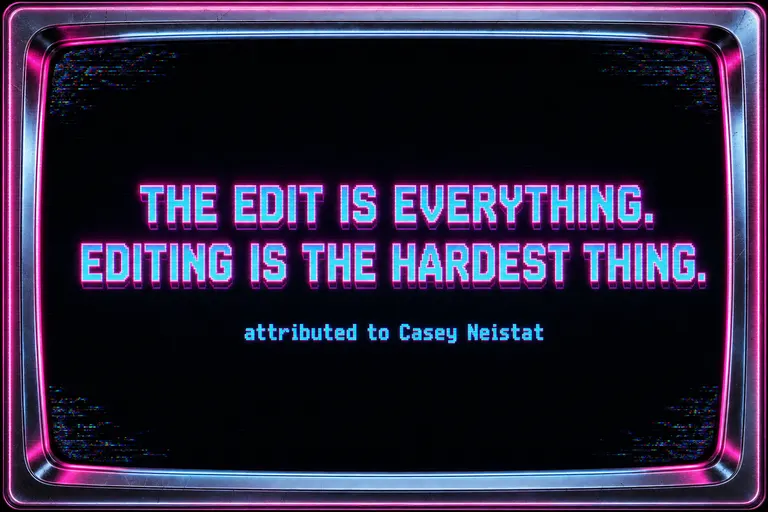
A VHS title card rendering Casey Neistat's quote 'The edit is everything. Editing is the hardest thing.' in chunky 80s-arcade typeface
The Hank position, quoted accurately
Hank Green is, and I say this as a coach who recognizes another coach, a teacher first. That changes the shape of his argument about AI.
In his March 2026 Slate interview about converting Complexly into a nonprofit, Hank says:
"One of the crazy things about A.I. as it currently stands is that it's an engine of media."
He talks about chatbots producing aggregate output that becomes "a kind of media now." He talks about the way recommendation algorithms "took over our brains 10 years ago with what gets recommended to us." He pushes for media literacy: "You should understand what your brain is doing and what they are doing to your brain."
Hank is not against tools. He is against engines of media that run by themselves, optimizing for engagement instead of for the audience's actual life. AI training on YouTube creators without consent, AI-generated channels gaming the recommendation feed, the broader brainrot economy. He's right. The brainrot economy is also real.
But here is the subtlety: Hank's worry is about generation, not editing. He is worried about content that is invented from nothing, by no one, for nobody in particular — the "engine of media" running on its own. That is a different thing from a creator with a story, a camera, a shoot, and a tool that helps them assemble what they captured into what they meant.
If anyone in the anti-slop camp should be sympathetic to "let the AI handle the mechanical part so the human keeps the editorial part," it's the man who built a multi-million-student education platform by systematizing the boring parts so the teaching could breathe. Crash Course was, at its core, a coach saving a teacher's time so the teaching could show up. That's what we tried to be. The coach saving the creator's time so the creating could show up.
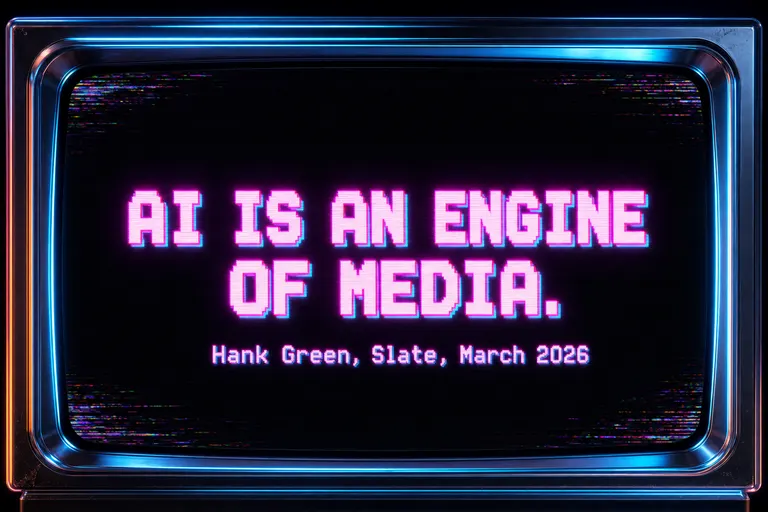
A VHS title card rendering Hank Green's quote about AI as an engine of media in chunky 80s-arcade typeface
The false equation
Here is the equation the broader anti-AI-editing camp keeps writing on the locker-room mirror: See editorial AI in action free
caring = clicking
It looks innocent. It feels intuitive. It is the equation behind every "real editors hand-cut every frame" tweet, every "AI is for lazy creators" comment, every "if you used AI in the edit, did you really make it?" thread.
But check the math. *The clicks are a symptom of caring under a constraint — the constraint being that, for thirty years, the only way to express the editorial decision was to physically perform it with a mouse on a timeline. The clicks were never the caring. The clicks were the cost* of caring.
You wouldn't say "running is dragging your knees." Knees come along for the ride because that's how running used to work. Show a runner a working pair of legs and they don't say "but my knees!" They run.
Same in the gym. *You are not lifting heavier. You are just lifting longer. Sitting at the timeline for nine hours, dragging clips one frame at a time, doesn't make you a stronger editor than the creator who sat at the timeline for one hour and made the same three high-stakes decisions. It makes you a more exhausted* editor. There is no medal at the bottom of the exhaustion. There's just an edit that didn't get made on Tuesday because you were still cleaning up Monday's.
Caring is what the cut feels like. Caring is taste × pacing × mood × story. Caring is the decision you made when you watched the rough cut at hour two and went "no, the laugh has to land before the cut to the wide." That decision took half a second. The execution of that decision — finding the laugh on the timeline, marking it, splitting the clip, rippling the rest, dragging the wide to land — took fifteen minutes.
The half-second is the caring. The fifteen minutes is the captivity.
::
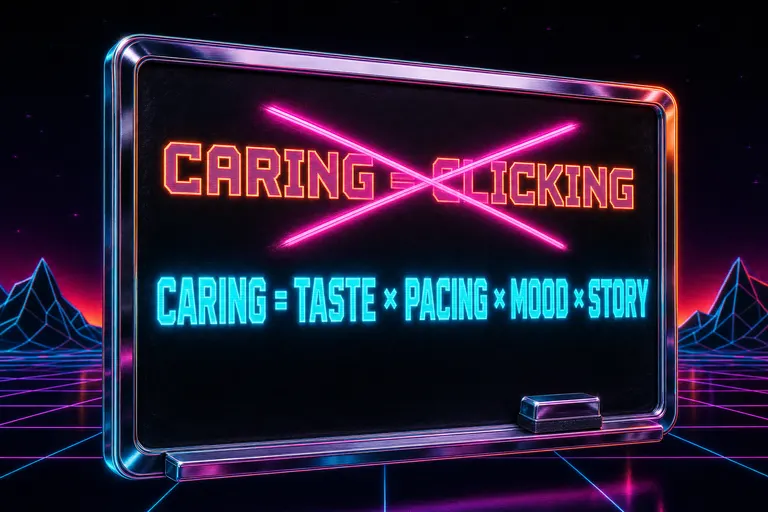
A diagram showing the equation 'CARING = CLICKING' crossed out by a magenta neon X, with 'CARING = TASTE × PACING × MOOD × STORY' written below
Where caring actually lives
Run the tape back on any video that actually made you feel something. A wedding film that made you cry in the parking lot. A vlog that made you laugh on the train. A documentary scene that made you forget your hand on your phone.
What got you there?
It wasn't that the editor clicked the razor tool 487 times instead of 486. It wasn't that they nudged a fade one frame to the left in After Effects at 2am. *It was the choice of the cut. It was the held beat. It was the held silence. It was the music coming in two seconds later than you expected. It was the wide held three frames longer than felt safe. It was the cut to the close-up right* on the breath, not the line.
Those are the editorial moves. They are 20% of the time and 100% of the feeling.
The rest — call it the 80% — is the mechanical labor of getting your timeline to a state where those 20% editorial moves can even show up. Sorting through twelve clips to find the one with the laugh. Trimming dead air. Smoothing a jump cut. Spotting B-roll. Generating captions. Aligning the audio. Building the first draft of the assembly so you can react to it.
Casey Neistat does that 80% himself. He's earned every one of those hours because he genuinely enjoys the cooking. He owns the kitchen. He owns the knives. He owns the heat. Good.
But here is the asymmetry: the average creator in 2026 is being asked to ship three Reels a week, a TikTok every day, a long-form every Saturday, a podcast every Tuesday, and a client cut on Thursday. They cannot do the 80% by hand. There aren't enough hours. There aren't enough Saturdays. There aren't enough wrists.
So they have a choice:
1. Skip the 20% editorial work because the 80% mechanical work ate the day. (Result: flat content, burnout, churn out of the creator economy.) 2. Skip the volume because the 20% needs space. (Result: get punished by the algorithm, lose income, churn out of the creator economy.) 3. Let a tool do the 80% mechanical work so the 20% editorial work gets its real Saturday.
The third option is the only one that survives the math. That is what VibeChopper was built for. We did not build a generator that invents pixels you didn't shoot. We built an editor that does the cooking under the chef's direction.
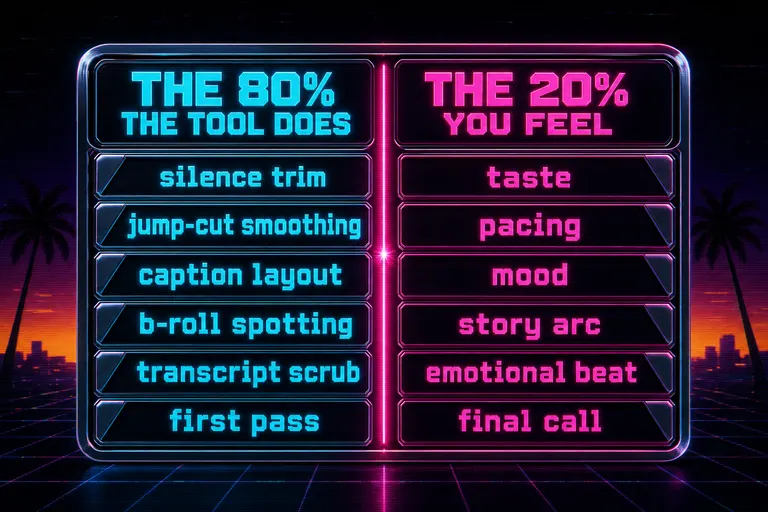
A diagram of two columns labeled 'THE 80% THE TOOL DOES' and 'THE 20% YOU FEEL', with sample items under each column
How VibeChopper was editorial AI, not generative slop
If you remember nothing else from this post, remember this distinction. It's the whole game. Try a chat-driven edit
Generative AI invents pixels. You type "a city at sunset." It hands you a city at sunset. Nobody shot it. Nobody was there. Nothing happened. The video is novel and spiritually empty. As Foxit's piece on the authenticity premium put it, it's "an endless stream of content that is visually novel but spiritually hollow." That's the slop Casey and Hank are right to worry about. It does not deserve a defense.
Editorial AI edits the footage you shot. You point it at the wedding you filmed, the podcast you recorded, the vlog you walked through. It pulls together what you actually captured into a shape you actually meant. Every frame in the output was a frame in your input. Every word in the cut came out of someone's actual mouth in actual time. The AI is not a writer. It's an extremely fast editor who never gets tired, never gets bored, and never overrules you.
When you opened VibeChopper, the AI did none of these things: it did not generate a city it had never seen, it did not write a script about your life, it did not invent a voiceover you never recorded, and it did not fabricate footage. It cut footage.
It did all of these things: it described every frame of your shoot so you could find the take you remembered. It transcribed every word you said so the chat could trim by language, not by timestamp. It assembled a first draft of your edit from your clips. And it showed its work — every cut it made came with a receipt naming the clip and the moment.
That last one is the whole ballgame. The receipt is the difference between a tool and an oracle. Generative slop hands you a finished video and dares you to like it. Editorial AI hands you an assembly and shows you, line by line, which of your shots it used and why. You can override every line. You can re-prompt every cut. You can roll back the edit to a snapshot from twenty minutes ago. You are the director. The AI is the fastest, most patient junior editor who genuinely does not mind that you changed your mind again.
For the locker-room wall: generative AI makes the chef irrelevant. Editorial AI makes the prep cook unnecessary. We were the second one. We made the prep cook unnecessary so the chef could finally cook on a Saturday and still get the gym in.
::
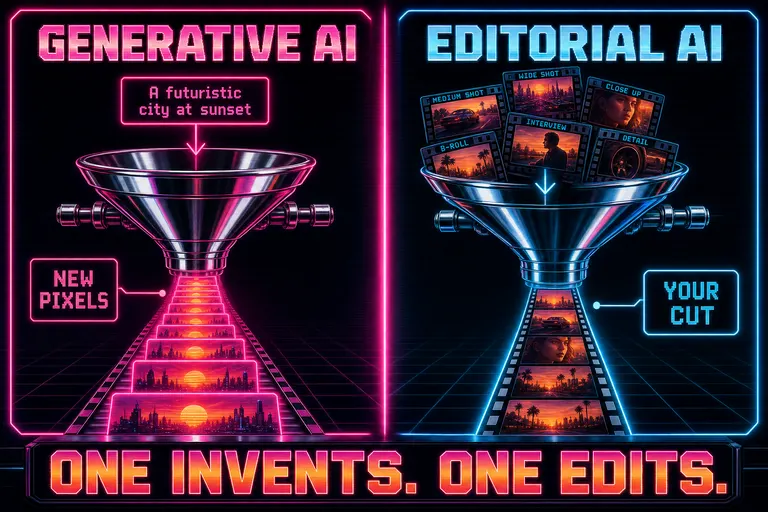
A diagram contrasting GENERATIVE AI (pixels made from prompts) and EDITORIAL AI (cuts made from your footage)
A working definition of "caring with AI"
Caring with AI is not "set it and forget it." Caring with AI is moving where you put the caring. Here's what good practice looked like.
You picked the shoot. That's still a creative decision. No AI showed up at the wedding. You did. You held the camera through the first dance. You got the shot of the bride's grandfather laughing.
You wrote the brief. Three sentences. "A six-minute wedding film for the bride's family. Warm. Funny. The grandfather laugh is the emotional center. End on the first kiss as a dawn shot." The AI read the brief, every frame, every transcript line, and proposed an assembly. You did not say "make a wedding video." You told it what this wedding video was supposed to feel like.
You watched the assembly. Forty minutes of footage down to a six-minute first cut, in the time it took you to brew coffee. You watched it the whole way through. You felt where it was working and where it was lying. That's caring. The clicking was zero. The caring was full.
You called the editorial moves. "Hold the grandfather laugh four more frames. Lose the dance-floor montage. Pull the first kiss to minute four. Drop the score in two seconds later. Cut the second toast in half." Each of those was a sentence. Each of those, in the old workflow, was twenty minutes of clicking. You moved the caring to where it counted. You did not move it away.
You finished the rep yourself. There is a moment in every cut where you take the trackpad back, lean in, and finish the last two beats by hand. That hasn't gone away. We never tried to take it away. Royalty-free music libraries are the soggy salad of editing — they're the bad version of taste. AI in the edit was the meal-prep service. You still seasoned the plate.
You shipped. Sunday morning. The bride cried. The grandfather cried. Your back wasn't out. Your Saturday wasn't gone. Your partner saw your face at dinner.
If anyone wants to look at that workflow and tell me the wedding video cared less than the version where you spent eleven hours dragging clips with a mouse, they have to explain to me which of those decisions a mouse was making.
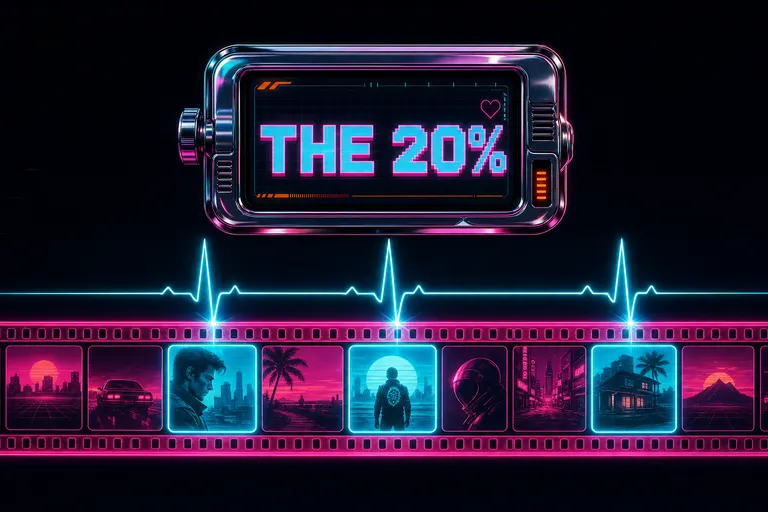
A heart-rate monitor overlaid on a glowing filmstrip, the heartbeat spiking at three specific frames that are glowing brighter than the rest
The craft was never in the mouse
"But what about the craft?" I hear this objection in my sleep. It deserves a real answer.
The craft is not the mechanics. The craft is the judgment. Every generation of editors has had this argument with the generation before it. The cinema editor said the linear-tape editor was a sellout. The Avid editor said the Premiere editor was a sellout. The Premiere editor said the iPhone editor was a sellout. None of them were right. The craft survived every one of those tool changes because the craft was never living in the tool. It was living in the editor's eye.
Casey writes in the edit because his taste is the writer. The taste survives the change of tool. The taste survives the change of decade. If he ever tries a chat-first editor and decides he prefers his Premiere muscle memory, I will not argue with that for one second. The muscle memory is real. The muscle memory is sacred for the people who built it. But the muscle memory is the path he took. It is not the only path.
And the audience knows it. Becky Owen of Billion Dollar Boy put it cleanly in Digiday: "AI can't replicate the messiness of human creativity. We crave that now, we crave imperfection and things that feel 'off' in a human way." She's right. They crave a real person doing real things. Editorial AI does not replace the real person. It frees the real person to do more real things on more real Saturdays.
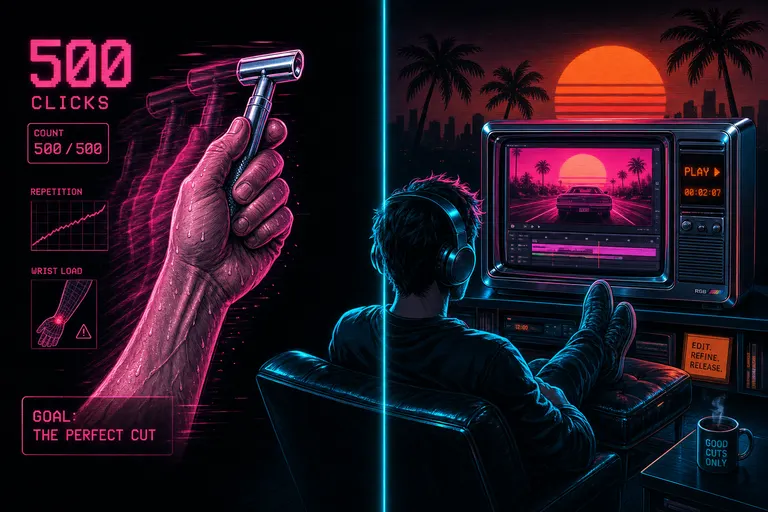
A split illustration: on the left, a wrist clicking a razor tool 500 times in a blurred motion; on the right, the same creator with their feet up watching the cut on a CRT
The Gnarles closer
So here's where I land, hand on the rope, looking across the ring. Get your power back
I respect anyone who can sit at a timeline for nine hours. I do. That's a heavy lift. That's deadlifting the edit. That's going to failure and coming back. The hours are real. The reps are real. The muscle is real. Nobody is taking that away from you, and nobody should.
But you know what's also a heavy lift? Caring about a video for nine months instead of nine hours. Holding a story in your head across thirteen Reels, fifty-two posts, four hundred Saturdays in a row. *Most creators don't get to choose between caring and clicking. They have to choose between caring and clicking. Hand-editing every frame is one form of devotion. Pacing, score, mood, story arc — those are forms of devotion too*, and they're the ones an audience actually feels.
So when somebody says "if you really cared, you'd do the clicks yourself," I hear it as a sentence that is true for them — Casey, Hank, anybody whose volume is bounded and whose name is on the door — and false for the thousand creators behind them who are trying to build a career in the same medium with one-tenth the team and one-third the timeline. The clicking is not the love. The clicking is the tax on the love.
We built VibeChopper to let you stop paying that tax.
AI does not make you care less. It moves where you put the caring.
That's the whole line. That's the whole post. If you remember nothing else from these 3,400 words, remember that. Put it on the back of your sweatshirt. Tape it to your monitor. The next time someone tells you a chat-driven edit can't have a soul, hand them their video back and ask them which frame the soul lives in.
Spoiler. It lives in the part where you cared. And we made sure that part is still yours.
::
Reps in. Reps out. See you on the timeline.
— Gnarles
---
Related reading:
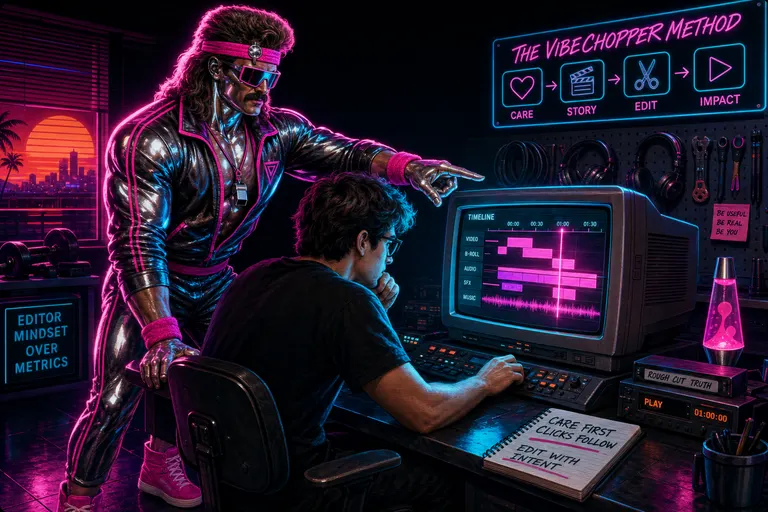
Gnarles Chopper standing behind a creator at a synthwave editing bench, one hand on the bench, the other gesturing at the glowing timeline like a gym spotter
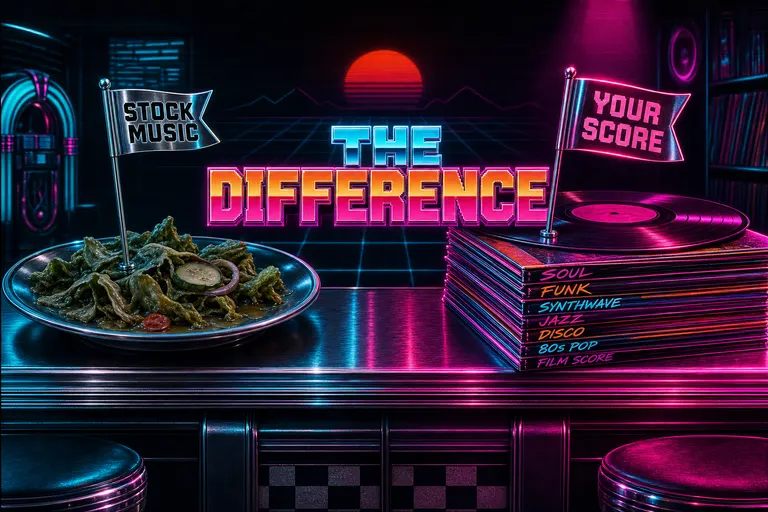
A chrome plate of wilted royalty-free salad next to a neon stack of well-chosen vinyl records, captioned 'THE DIFFERENCE'

A synthwave gym at sunrise: a chrome editing bench in the foreground, a glowing timeline ringing the room like a running track, the sun cresting the grid horizon
Try the workflow
Open every feature from this post in the editor
These panels collect the features discussed above. Sign in once, finish your profile if needed, then the editor opens the first highlighted surface and walks through the tutorial.
Step 1
See editorial AI in action
Every cut comes with a receipt — the clip it touched, the transcript it pulled, the reason it picked that beat. Not generated. Edited.
See editorial AI in action free →Step 2
Try a chat-driven edit
Open the chat. Tell it what you want the cut to feel like. Watch the timeline obey your taste, not your wrist.
Try a chat-driven edit →Step 3
Move your caring where it matters
Read the full case for putting creators back in the director's chair, instead of the razor-tool's.
Get your power back →