
Overview
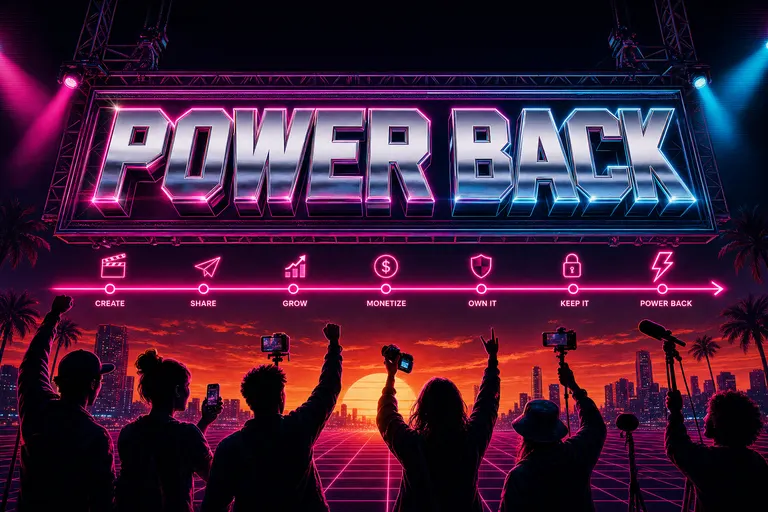
A massive chrome banner reading POWER BACK floating above a glowing magenta timeline with the silhouettes of creators raising their hands toward it
The cost of editing
We need to start with the bill.
Not the subscription bill. The other one — the one that doesn't show up in your inbox. The one paid in 1am hours, missed dinners, fights with your partner, the third draft you knew was the right one but couldn't face exporting. The bill creators pay every week to keep doing the thing they love.
You know the math. A twenty-minute raw recording — one talking-head take, a couple of cutaways, nothing fancy — takes three to four hours to cut. That number isn't us being dramatic. That's the Klipa AI writeup, in plain language: "A 20-minute raw recording can easily take 3-4 hours to edit." Multiply that by three Reels a week. Multiply that by a year. That's a part-time job nobody is paying you for, and it's a part-time job that lives inside the timeline.
Then look at what it costs to even sit down at the timeline. Adobe Premiere Pro, in May 2026, costs $19.99 to $34.49 a month depending on which tier you're stuck with — student, annual prepaid, annual paid monthly, or the month-to-month plan (Costbench keeps the receipts). If you're a working creator on the flexible tier, that's $34.49 a month for the right to spend your nights editing. The median Premiere subscriber pays roughly $297 a year for the privilege.
CapCut was the cheap escape. It isn't anymore. In January 2026, CapCut Pro's annual subscription jumped from $77 to $179.99 — a hundred-dollar hike — and 1080p and 60fps exports got locked behind the new paywall. The viral post that captured the room came from VTuber MIGI VT: "Not only has Capcut been absolutely BROKEN for the past day and a half, but they're increasing the pro subscription by A HUNDRED DOLLARS." Reddit thread title from the same week: "the DEATH of CapCut."
Then there's the bill that's hardest to read because it isn't a number — it's a feeling. 62% of full-time creators reported burnout symptoms in 2026: exhaustion, cynicism, reduced efficacy. TheCreatorEconomy put it on the page in black and white. 71% said their workload had increased significantly over the past two years. 81% worked more than 50 hours per week, including weekends. 47% had considered leaving content creation in the past six months.
Read those numbers slow. Almost half the people doing this for a living are thinking about quitting. The single biggest time-sink in their week is the same one in every survey we've ever read: the edit.
We built VibeChopper because we got tired of paying that bill. We got tired of watching every creator we loved pay it. And we got tired of pretending the bill was the cost of caring.
It isn't. The bill is the cost of the tool.
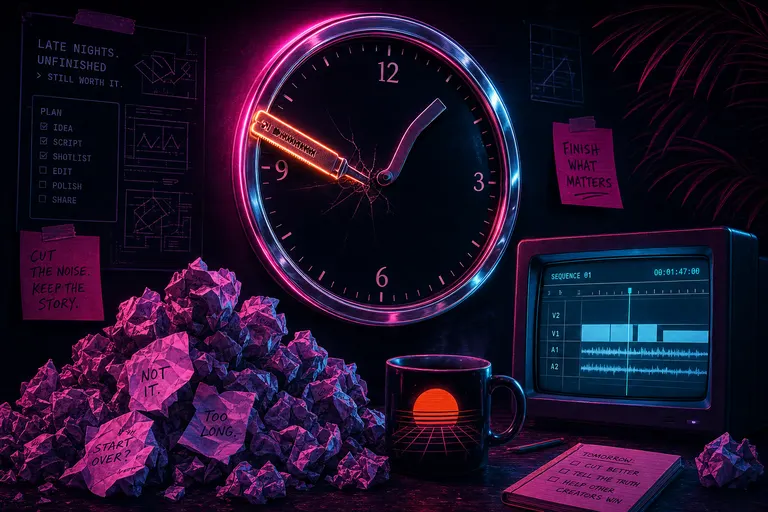
A chrome wall clock at 1:47am with a frozen razor tool stuck inside its face, surrounded by a small mountain of crumpled drafts and an unfinished cup of coffee
Name the gatekeepers
Let's name them, plainly, with no snark. Every one of these tools deserves respect for what it built. We're not here to dunk. We're here to point at the wall they all built around the same room.
Adobe Premiere Pro. Premiere taught a generation how to cut. The clip-bin model, the multi-cam workflow, the Lumetri color grader, the keyframe stack — that vocabulary is the lingua franca of every editor working in film and television in 2026. We owe Premiere that. We also owe it the truth: $19.99 to $34.49 a month is the price of professional editing for a working creator, and that's before plugins, before the rest of Creative Cloud, before the GPU you needed to render 4K without stuttering (Costbench). If you cut Netflix documentaries, that bill is rounding error. If you cut a Reel on Sunday night so you can post on Monday morning, that bill is the wedge between you and consistency.
DaVinci Resolve. Free, brilliant, and built by people who clearly love the craft. It is also the steepest learning curve in the room — Blackmagic's own training pages list certification paths that take months to complete, and the consensus on the "is DaVinci hard to learn" SERP is yes, eighty hours of YouTube tutorials minimum before you're shipping. Free is not free when free costs you a quarter of a working year.
CapCut. The mobile-first editor that taught a billion phones how to cut. Templates, captions, effects, all for free, all on the device you already had. And then in January 2026, the Pro tier doubled, and 1080p and 60fps were locked behind the paywall, and the platform stopped feeling like the friend you grew up with and started feeling like every other tool that decided you were a revenue line. ByteDance owns CapCut. ByteDance owns TikTok. The lock-in is the product. Creators feel it.
iMovie. Final Cut. Filmora. Descript. Veed. Camtasia. Premiere Rush. Lightworks. Kapwing. Every one of these is somebody's favorite tool. Every one of them is the right answer for some creator on some Tuesday. None of them, as a category, has stopped the bleeding on the bill we opened this post with.
That's the wall. The wall is built from three bricks: the subscription tax, the learning curve, and the "you should suffer to make good art" myth.
Burnout isn't a character flaw. Burnout is a wall.
The third brick is the meanest one because it's the one creators do to themselves. The myth says: if you didn't sit at the timeline for nine hours, the cut isn't yours. If the AI moved the clip, you cheated. Real editors hand-trim every frame. Real creators suffer.
We reject that myth. We reject it on behalf of the woman who shoots a wedding on Saturday and has to deliver by Friday and has a two-year-old at home. We reject it on behalf of the kid who runs a YouTube channel out of a bedroom and has class in the morning. We reject it on behalf of every creator who has ever stared at a razor tool at 1:47am and thought I don't think I can do another one of these. The cut is yours when you decided what the cut should feel like. The wrist is not the part that matters. The wrist was never the part that mattered.
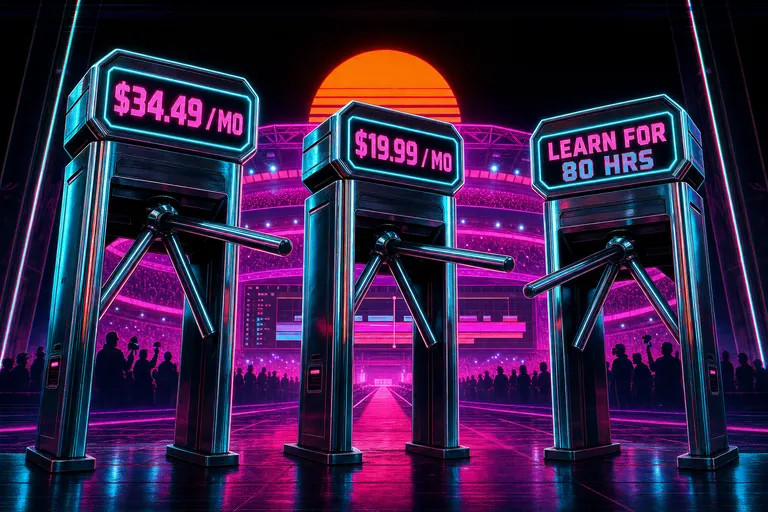
Three towering chrome turnstiles labeled with subscription prices blocking the entrance to a glowing neon timeline arena
What "power" actually means for a creator in 2026
Let's get specific about the word "power," because every brand on the internet means something different by it. Get your power back
When we say power, we don't mean more buttons. We don't mean a deeper preferences menu. We don't mean a thousand presets you'll never use. We don't mean "pro features" gated behind a higher tier so you feel like a peasant on the free plan.
We mean four things, plainly:
Power means time. The hours of your life that the timeline ate. We want those back. Not "saved" in the marketing-bullet sense — back. Returned to you. Available for sleep, for a partner, for the second project you keep putting off, for a Sunday where you don't have to apologize to anybody.
Power means leverage. When you describe the cut, the cut happens. The directing voice in your head — the one that has narrated your footage for nine hours on the drive home — finally has hands. You're not translating your idea into a clip-bin operation and then a razor-tool operation and then a transition-panel operation. You're saying the cut and the cut is happening.
Power means independence from the wall. No $34.49 a month tax on showing up to work. No $179.99 a year hike with no apology and no warning. No eighty-hour tutorial debt before you ship your first Reel. The tool you depend on for your livelihood should not be allowed to change the rules on you on a Tuesday.
Power means taste-on-top. The thing that makes your work yours is your taste — the moments you pick, the pacing you choose, the music that lands on the right beat, the silence you hold for one more frame than feels safe. AI takes the tedium. You take the taste. That's the deal. We will not blur that line. We will never blur that line.
That diagram is the whole pitch. The before column is what creators told the burnout surveys. The after column is what shipped. Three steps. Upload. Describe. Ship. The hours don't vanish into a marketing bullet — they walk back into your week, looking for somewhere to sit down.
::
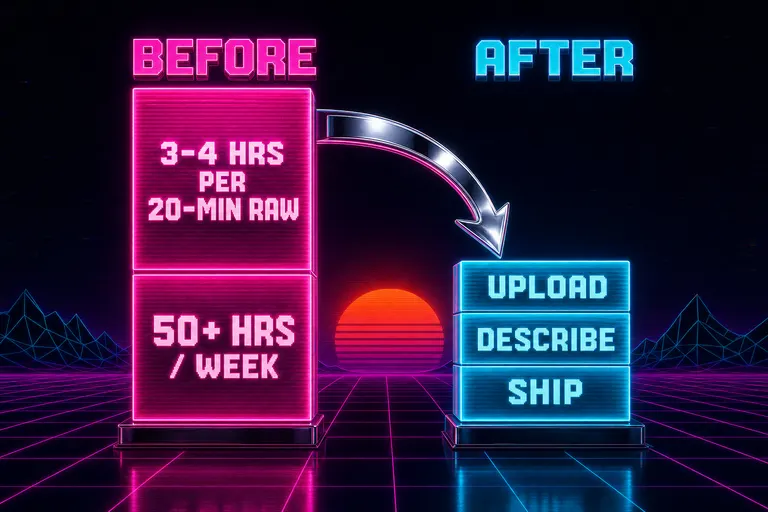
A two-column bar chart labeled BEFORE and AFTER. The BEFORE column shows a tall stack of bars labeled with hours; the AFTER column shows a much shorter stack
VibeChopper's bet
We bet on the conversation.
For thirty years, every video editor in the world was a surface of buttons. A bin on the left, a viewer in the middle, a timeline on the bottom, a properties panel on the right. You learned the buttons. You moved your mouse a hundred thousand times to get a five-minute cut. The buttons were the price of admission.
We bet that the surface of the future was a surface of intent. You don't tell a junior editor where to click. You tell them what you want the scene to feel like. You say "trim the first five seconds, the cold open should land on her laugh, drop a name card on the founder, cross-dissolve into the next scene, and tighten the dead air at the end." That's the brief. A good editor reads the brief, reads the footage, and makes the cut. You react. You revise. You direct.
VibeChopper turned that into the product. You drop the footage in. Frames get described every half second by the model. Audio gets transcribed with speakers labeled. Then you open the chat — or the voice button — and say what you want the cut to be. The AI reads your project. It writes a plan. The plan turns into tool calls. The tool calls move the clips. You watch your timeline obey the directing voice that's been narrating your shoot the whole drive home.
That's the bet. The conversation is the editor.
We bet on the conversation because the conversation is what creators were doing anyway — in their heads, in voice memos, in DMs to their editor friends. We just put the conversation directly in front of the timeline and removed the wrist that had been translating in between.
The audience never felt your razor tool. The audience never felt your keyframe stack. The audience never felt your nine hours at the timeline. The audience felt the cut — the moment the music dropped, the moment the camera held on her face, the moment the founder paused before answering. The audience feels the taste, not the tedium. We aligned the tool to that fact.
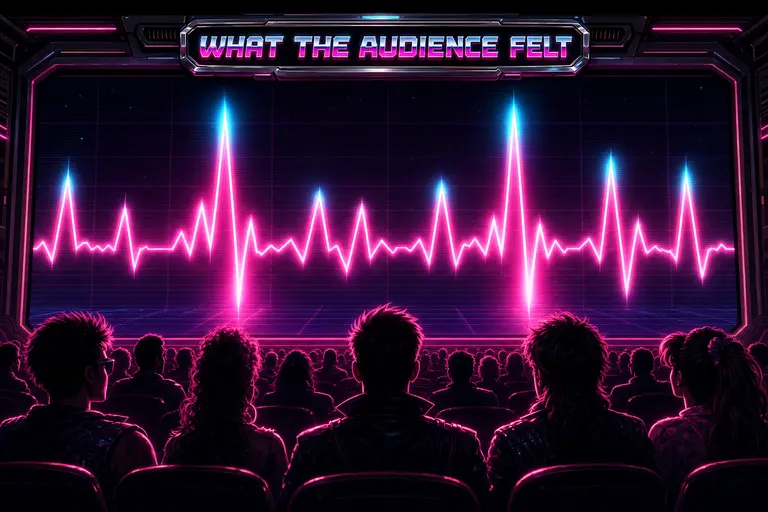
A glowing waveform shaped like a heartbeat ECG line running across an audience of synthwave silhouettes, the peaks of the waveform glowing brighter where the audience reacts
The line: tedium versus taste
This is the line we drew when we built VibeChopper, and it is the line we will not cross. Describe your first edit
AI takes the tedium. That means: finding the take buried in 47 GoPro angles. Removing the dead air between sentences. Adding a cross-dissolve at the right beat. Generating a lower-third when you didn't pre-build one. Picking a b-roll cutaway from your own footage. Polishing a rough cut for length without breaking the story. Normalizing audio. Transcribing every word. Describing every frame so you can search it later like a database. Drafting a thirty-second trailer from a four-hour shoot.
These are the tasks that ate your nights. These are the tasks the audience never sees and never felt. These are the tasks the AI got uncomplicatedly better at — not because AI is magic, but because pattern-matching across thousands of frames and tens of thousands of transcript lines is what models are good at, and is what wrists are bad at.
You take the taste. That means: which take is the soul of the scene. Where the music should swell. Which silence stays in. The exact beat the camera holds for one frame too long because that beat is the emotional weight of the scene. The pacing of the cold open. The decision about whether a section is honest or whether it's performing honesty. The choice to keep the awkward laugh because the awkward laugh is what makes the moment real. The audience's heartbeat moves at the pace of your taste. That belongs to you. Forever. No model will ever know your audience the way you do.
The model never overrules your taste. The model proposes. You decide. Every edit the AI made shipped with a receipt — what it did, what footage it touched, what transcript line it pulled, why it picked that beat. You could read the receipt. You could ask for a different beat. You could roll back and try again. The receipts kept us honest. The receipts kept the taste yours.
This is what we mean by AI as an amplifier, not a replacement. The voice in your head — your taste — runs through the amp — VibeChopper — and what comes out the other side is your cut, louder. Not someone else's cut. Not a templated cut. Not a slop-feed homogenized cut. Your cut, amplified.
If we ever build a feature that asks you to surrender your taste — that picks the take instead of recommending one, that locks you out of the override, that makes the cut feel less like yours — we will have broken the deal. We won't. That promise is in the foundation.
::
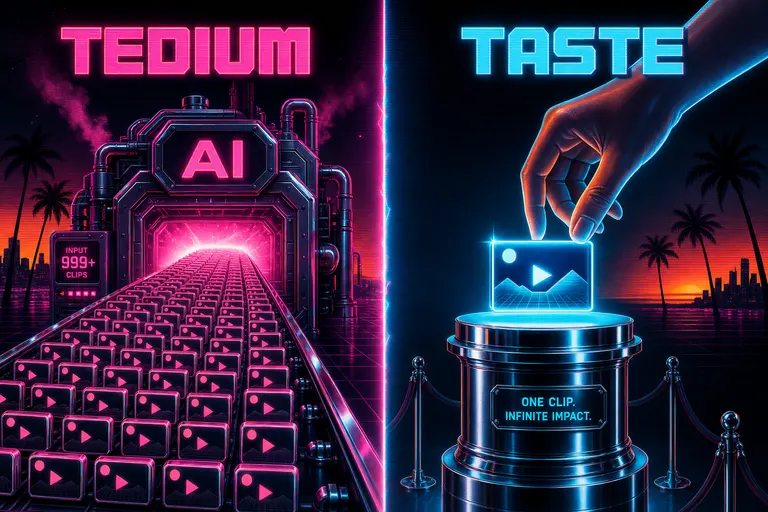
A split-screen image. On one side a chrome conveyor belt labeled TEDIUM carries hundreds of identical clip thumbnails into a furnace; on the other a single creator hand labeled TASTE places one glowing clip onto a pedestal
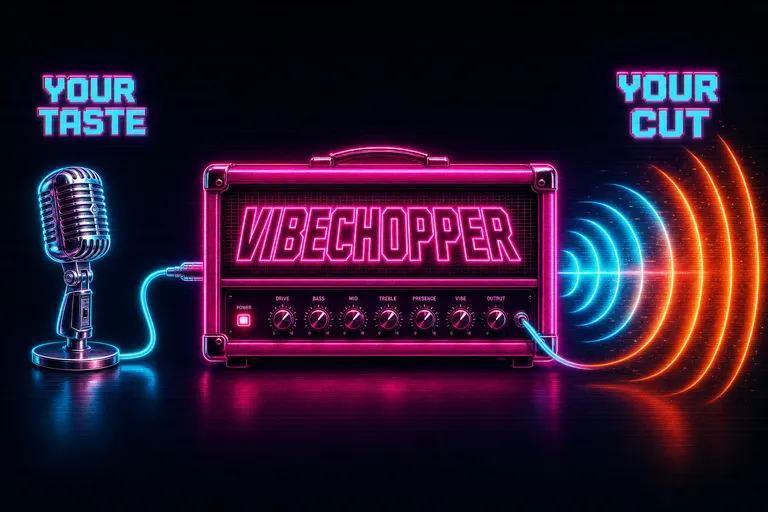
A diagram showing a small chrome microphone labeled YOUR TASTE wired through a glowing pink amplifier labeled VIBECHOPPER, with sound waves labeled YOUR CUT booming out the other side
What we built so the deal could be real
We're not asking you to take the deal on faith. We shipped the receipts.
We shipped chat-driven editing so the conversation moves the timeline. We shipped voice-first input so you can direct a cut on the subway, on a walk, in the car. We shipped frame-by-frame description — every half second of every clip — so your footage became searchable like a database. We shipped speaker-diarized transcripts so you could find the line by typing the line. We shipped AI voiceover so the cold-open script you've been hearing in your head exists in the world. We shipped AI music scoring so you didn't have to fight royalty-free music libraries for the right swell. We shipped the Polish button so dead air and jump cuts got tightened in a pass. We shipped story-structure editing so you could edit by arc, not by clip number. We shipped overlays and lower-thirds so you didn't have to open Photoshop. We shipped snapshot and time-travel so you could roll back any cut, any time. We shipped a universal app for iPhone, iPad, Vision Pro, and the web so the timeline lived wherever you already lived. We shipped share-without-export so a client could review the cut without you waiting forty-five minutes on a render. We shipped export-for-anywhere — MP4, FCPXML, EDL, WebM — so nothing you made was locked inside our tool.
Every one of those features is a brick we took out of the wall.
This part is the locker room. We're standing in front of the whiteboard. We're pointing at the play.
The play is: shoot, describe, ship, rest. Four steps. A loop you can run every day without bleeding. A loop where the AI is the gym partner, not the gym owner.
We left REST on the loop on purpose. Most creator tools forget rest. Most creator tools assume your bottleneck is motivation and design a notification system to push you harder. We assumed your bottleneck was the tool, and we designed a workflow that gave you back the hours so rest was finally available again.
If you finish your edit and you still have a Saturday left, the loop worked.
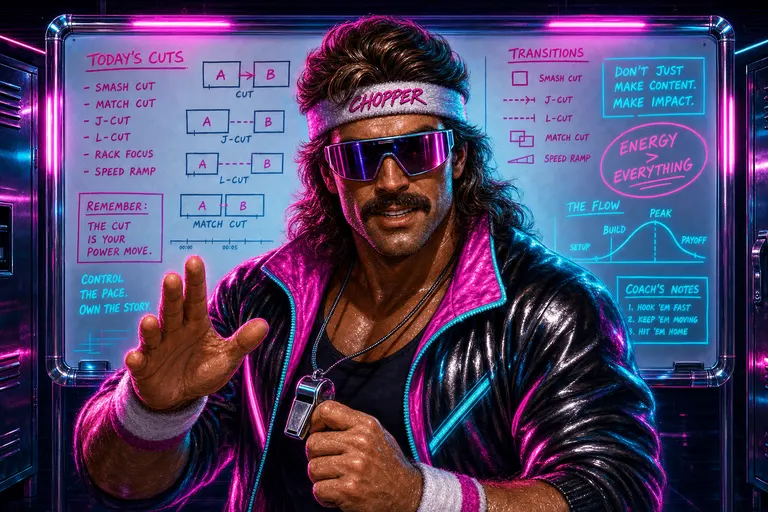
Gnarles Chopper in a sweatband and warmup jacket stands in front of a chrome locker-room whiteboard covered in cuts and notes, one hand raised mid-coach, the other gripping a chrome whistle
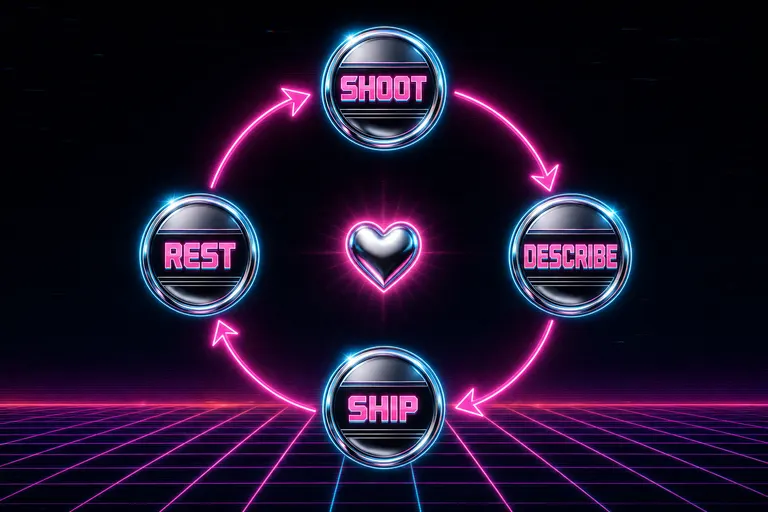
A circular feedback loop diagram with four nodes labeled SHOOT, DESCRIBE, SHIP, REST, glowing arrows running clockwise between them
The invitation
So here's the invitation. We're going to write it plain. Start free
You didn't spend three years learning how to edit so you could spend your Saturdays clicking a razor tool five hundred times. That's not power. That's captivity. The timeline was a tool that was supposed to serve you, and somewhere along the way you started serving it.
We built VibeChopper to put the power back where it always belonged: in the part of you that knows what the cut should feel like. Not the wrist. Not the muscle memory. Not the eighty hours of YouTube tutorials. The part of you that watched the take and knew — that was the one. That was the soul of the scene. That voice was always right. We just built a tool that could finally hear it.
If you've been editing at 2am, we wrote this for you. If you've been thinking about quitting, we wrote this for you. If you've been paying $34.49 a month for the right to spend your nights doing wrist-work the audience never felt, we wrote this for you. If CapCut doubled its price on you in January and you're still mad, we wrote this for you. If you watched a friend burn out of the creator life last quarter and you're worried you're next — we especially wrote this for you.
Drop in a shoot. Describe the video you wanted. Watch the timeline obey.
That's the whole thing. That's the deal we built. That's the bet we made.
If we did our job, the hours come back. The cut still feels like yours. The audience still feels the moment. And on Saturday, when the edit's done, you get to do something that isn't editing.
We want creators to make more videos. We want creators to make better videos. And we want creators to make those videos without bleeding out the parts of their life that made the videos worth making in the first place.
That's the power we want to give back. That's why this exists.
::
We'll see you on the timeline.
— Gnarles
---
Further reading from the locker room:
- You're Not a Bad Creator. Your Editor Is Eating Your Life. — the long-form version of the burnout argument, with the math and the receipts.
- Theo, We Heard You: A Builder's Reply on AI Video Editors — a real conversation with a real skeptic, written in good faith.
- Casey, Hank, and the Myth That Caring Equals Clicking — on the artisan-myth and why AI doesn't make you care less.
- "Vibe Editing" Is Already a Thing. Here's What It Actually Means. — the category we're claiming and what it actually is.
- The Tweet That Started VibeChopper — where this whole thing came from, in Steve's own words.
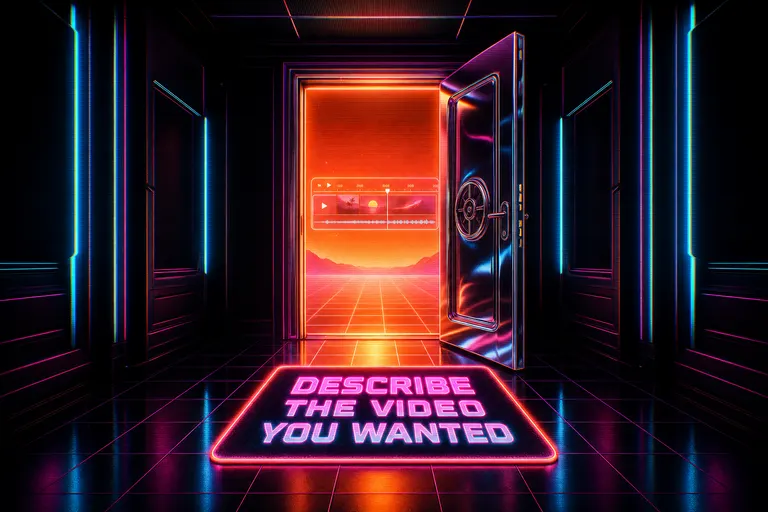
An open chrome door at the end of a neon corridor with a glowing welcome mat that reads DESCRIBE THE VIDEO YOU WANTED
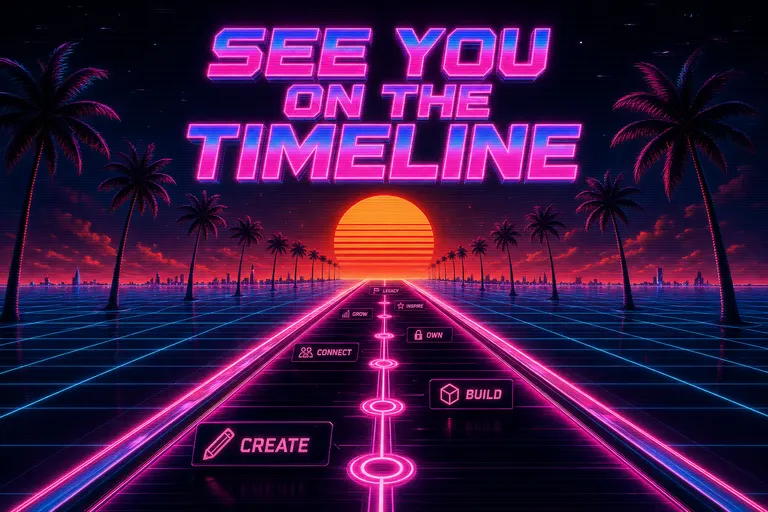
A glowing magenta timeline shaped like a road stretching toward a chrome sunset over a grid-floor horizon, palm-tree silhouettes flanking it, the words SEE YOU ON THE TIMELINE floating in the sky
Try the workflow
Open every feature from this post in the editor
These panels collect the features discussed above. Sign in once, finish your profile if needed, then the editor opens the first highlighted surface and walks through the tutorial.
Step 1
Get your power back
Drop in a shoot. Describe the video you wanted. Watch the timeline obey.
Get your power back →Step 2
Describe your first edit
Open the chat. Say the cut out loud. The AI reads your footage and makes it.
Describe your first edit →Step 3
Start free
No card. No 80-hour learning curve. Just the timeline that finally listens.
Start free →